
August 11, 2026 · Gunsmithing Tips
Most firearm work involves trade-offs. A lighter trigger against positive engagement, a smoother action against spring rate, cost against how far a job is taken. On a carry or home defense handgun one of those trade-offs stops being available, and it changes how the whole conversation goes.
The firearm has to work. Not usually, not after a break-in period, not with the ammunition it likes. Every time, first time, with whatever is actually in it. That single requirement sets the ceiling on everything else we might do to the gun, and being clear about it up front saves customers from paying for work that quietly undermines the reason they own it.
Why the Standard Is Different Here
A light strike on a range gun is a story you tell afterwards. The same light strike on a defensive handgun is a failure at the exact moment the firearm exists to work. Nothing about the mechanism is different; what changes is the cost of the failure, and that has to be reflected in where the limits sit.
In practice that means we are more conservative on a carry gun than on a competition gun, and we will say so when a request pushes past what we think the firearm will do reliably. Sometimes there is another route to the same feel, usually by addressing bearing surfaces properly rather than reducing spring rate further. Sometimes the honest answer is that the request is not appropriate for this particular firearm and this particular use.
That is not us being difficult. A customer who leaves with a trigger they love and a pistol that occasionally does not fire has been badly served, whatever they asked for at the counter.
Round Count Is the Wrong Metric
Carry guns tend to have low round counts and high handling counts, which makes the usual service intervals misleading. A pistol that has fired two hundred rounds in three years has still been carried for a thousand days, drawn and reholstered, exposed to sweat, lint, dust, and whatever else lives in a pocket or a holster.
In Las Vegas and Henderson the dust element is not trivial. Fine particulate finds its way into a carried firearm continuously, not only when it is fired, and it collects in exactly the places where it interferes with movement. A carry pistol here needs attention on a time basis rather than a round basis, and owners who think of service as something triggered by shooting tend to go too long.
What Accumulates in a Carried Handgun
The specifics vary by how it is carried, but the pattern is consistent.
- ◆Lint and fabric fibres, particularly in and around the striker or firing pin channel
- ◆Fine dust worked into the rails and the fire control area
- ◆Sweat and skin oils on external surfaces, which matter for corrosion
- ◆Old lubricant that has collected debris and stopped doing its job
- ◆Wear on the finish at contact points from drawing and reholstering
- ◆Magazine springs and feed lips, which see constant load and get overlooked
That last item deserves its own mention. Magazines are consumable and they are the most common single cause of feeding complaints we see on semi-automatic pistols. A tired spring or a damaged feed lip produces symptoms owners attribute to the pistol, and the fix is frequently far simpler and cheaper than they expected.
Holsters and What They Do to a Pistol
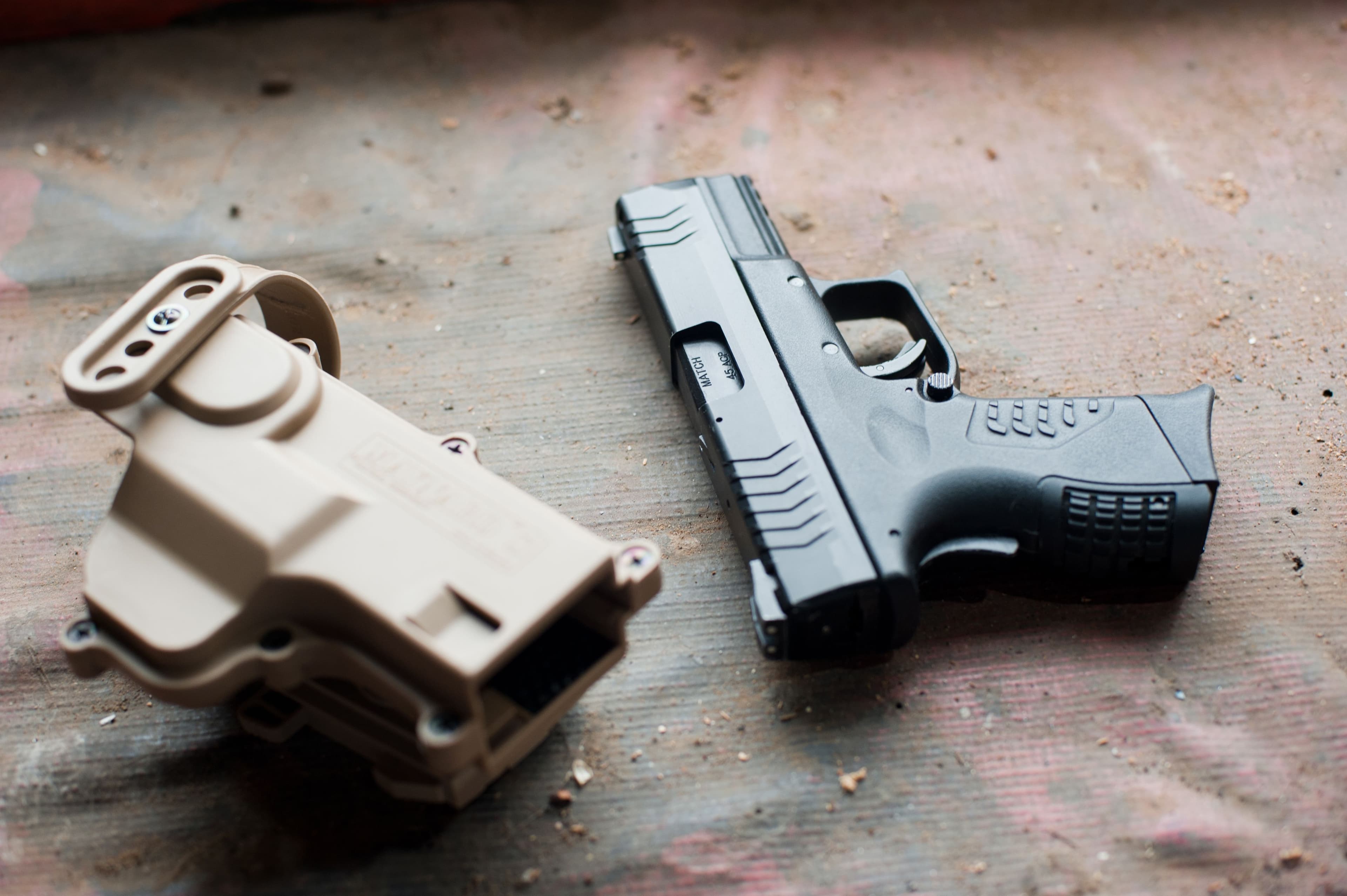
The holster is part of the system and it gets almost no attention in conversations about reliability. It is in contact with the firearm all day, every day, and over years that contact does things worth knowing about.
Finish wear at the contact points is the visible part and it is mostly cosmetic. The parts that matter more are less obvious. A holster that has softened or collapsed can allow debris in and hold it against the firearm. A worn or poorly fitted one can put pressure on controls, and a retention device that has loosened over time is not doing the job it was chosen for.
There is also the question of what the holster puts against your sights. Repeated drawing and reholstering against a rigid material is a genuine source of the sight movement described elsewhere on this site, and a rear sight that has walked slightly is easy to miss because it happens gradually.
None of this means replacing a holster frequently. It means that if you are having a carry pistol looked at, bringing the holster along is useful. We can tell you whether wear on the firearm is tracking to something about how it is carried, which is a more durable fix than addressing the symptom on the gun alone.
What a Function Check Covers
When a defensive handgun comes in, the assessment is deliberately broader than whatever prompted the visit. The point is to establish that the firearm is dependable overall, not only that one symptom has gone away.
- ◆Overall condition, wear at contact points, and any corrosion
- ◆Fire control condition, including engagement surfaces and springs
- ◆The striker or firing pin channel, which is where lint accumulates
- ◆Feeding, extraction, and ejection through the full cycle
- ◆Magazine condition, including springs and feed lips
- ◆Sight condition and whether anything has shifted
- ◆Safety and decocker function where fitted
- ◆Cleaning to the level the pistol needs, then function testing before return
As always this describes what gets checked rather than how corrections are made. Fire control components on a defensive firearm are the last place for improvisation, and work there belongs on a bench with proper tools and someone trained to do it.
Revolvers Carried for Defense
Plenty of people carry a revolver, and the considerations shift slightly. Timing and lockup matter as they do on any revolver, and they are checked on every chamber. The double action stroke does more work than a single action one, so roughness has more places to develop.
The reliability constraint applies identically. A double action pull lightened past the point where it reliably ignites a primer has failed at the job that counts, and on a defensive revolver that is not a trade worth making. Our handgun work page covers revolver service alongside semi-automatics.
Sights on a Defensive Handgun
Sight work is one of the more common requests on carry guns and one of the more worthwhile. Factory sights vary considerably in how easy they are to pick up quickly, and improving that is a genuine functional change rather than a cosmetic one.
What matters from a service standpoint is that sights are installed properly and that they stay where they were put. A sight that shifts under recoil or from repeated holster contact is worse than the one it replaced. Our sight installation page covers the work in more detail.
When to Bring a Defensive Handgun In
The threshold is lower than for other firearms, deliberately. Anything intermittent is worth investigating rather than monitoring, because intermittent is precisely the failure mode that matters here.
- ◆Any malfunction at all, even once, that you cannot confidently attribute to a bad round
- ◆A trigger, reset, or slide that feels different from how it used to
- ◆A pistol that has been carried a long time without a proper clean and inspection
- ◆Sights that have shifted, or that you have started having trouble picking up
- ◆A firearm that has been dropped, submerged, or through anything unusual
- ◆A handgun that is new to you, or whose history you do not know
If you are unsure whether something qualifies, the answer for this category of firearm is usually yes. We would rather look at a pistol and tell you it is fine than have you carry one that is not.
Serving Owners in Las Vegas, Henderson, and Pahrump
We are based in Pahrump and see a steady stream of defensive handguns from owners across the Las Vegas valley, including Henderson. Many arrive for a first inspection after years of carry with nothing more than occasional cleaning, and those visits frequently turn up magazine wear, accumulated lint, or dried lubricant rather than anything dramatic.
Turnaround matters more on this category than most, because a carry gun out of service is a gun you are not carrying. Tell us at intake if that is a concern and we will give you a realistic timeline rather than leaving you guessing. Our gun repair page covers what happens when an inspection finds something, the FAQ page answers the practical questions people ask first, and the contact page is the quickest way to reach us.
Frequently Asked Questions
Why will you not lighten my carry trigger as much as I want?
+
Because reliability sets the limit on a defensive firearm. A trigger that breaks beautifully but does not reliably ignite a primer has failed at the only job that counts. If a request goes past what we think the pistol will do dependably, we will say so and explain the alternatives.
How often should a carry pistol be serviced?
+
On a time basis rather than a round basis. Carry guns have low round counts and high handling counts, collecting lint, dust, sweat, and debris continuously. In Las Vegas and Henderson conditions that accumulation happens faster than owners expect.
My pistol malfunctioned once. Is that worth bringing in?
+
For a defensive firearm, usually yes. Intermittent is exactly the failure mode that matters here, so anything you cannot confidently attribute to a single bad round is worth investigating rather than monitoring.
Could my feeding problem just be the magazine?
+
Very possibly. Magazines are consumable and are the most common single cause of feeding complaints we see on semi-automatic pistols. A tired spring or damaged feed lip produces symptoms owners attribute to the pistol.
Do the same rules apply to a carry revolver?
+
Yes. Timing and lockup are checked on every chamber, and the double action stroke has more surfaces where roughness can develop. The reliability constraint is identical: no lightening past dependable ignition.
How long will my pistol be out of service?
+
Tell us at intake that it is a carry gun and we will give you a realistic timeline rather than leaving you guessing. A defensive firearm sitting on our bench is one you are not carrying, and we treat that accordingly.